



Your brain wasn’t built for this speed of leadership
Spend five minutes scrolling through LinkedIn or any other social media, and you’ll find an endless stream of quick fixes: “Do these 5 hacks to boost productivity,” “Master this morning routine to become unstoppable.”
It’s human to crave instant relief from stress, pressure, and discomfort. My clients tell me the same thing: “I want something that works right now.”
Our brains love quick fixes. It’s a dopamine on demand. But brain wiring doesn’t bend that easily. For example, procrastination is a habit you’ve likely rehearsed since childhood, replaying it almost every day of your life. And now someone says a neat little calendar trick will rewire it? Come on! You know it’s not that simple.
The moment I connected the dots
For the past few years, working with leaders, I've noticed a repeating pattern: they wanted to rewire not just their habits, but their entire way of being. Beneath the strategies and the productivity hacks was a deeper desire:
How do I build a mind and body that supports me through difficulty, instead of just surviving it?
That’s when it clicked. Just as organizations, cities, and countries are racing to become more sustainable, our minds need the same kind of rewiring. Resources are limited, not just in nature, but also in the human brain.
And in today’s high-speed leadership environment, with AI reshaping industries and uncertainty everywhere, our mental resources are running on overdrive.
The brain's sustainability problem
Neuroscience confirmed that the prefrontal cortex (PFC)—the hub of conscious reasoning and decision-making—can handle only so much. Moreover, PFC doesn’t work alone; it’s deeply connected with other important brain structures, such as the amygdala, hippocampus, anterior cingulate cortex (ACC). This explains why quick fixes with surface approaches are not sustainable in the long run.
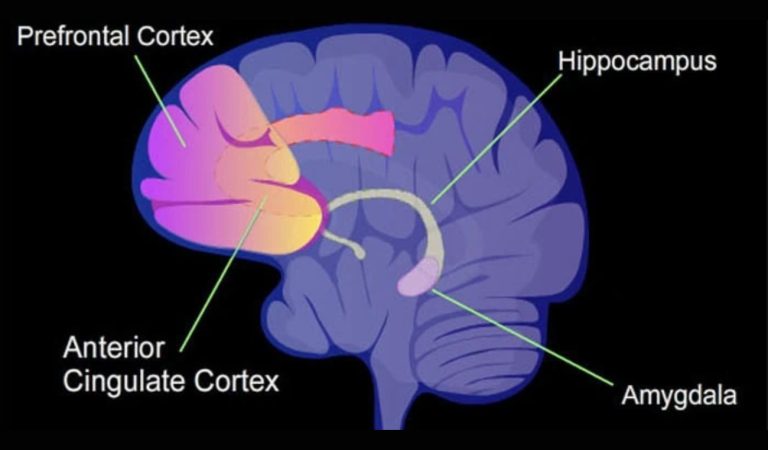
To better understand this, picture our brain as an electrical wire. At normal voltage, it works beautifully. But when the system around it is not supported, the PFC overheats. Sparks fly. The wire smokes, leaving only haze behind. That haze could be the brain fog of the following morning; I‘m sure you have experienced it. It’s the price of unsustainable mind management.
That is what is happening to leaders today.
Our brains are being asked to run at a voltage they were never designed or trained for.
The big idea: Sustainable Mindset™
A Sustainable Mindset™ is a mental infrastructure. It’s a rewired brain that can handle complexity, pressure, and uncertainty without dark smoke at the end of the day, or a brain fog the next morning. Lately, everyone talks about building sustainable business. Only a few talk about sustainable brains — the very source of every strategy, idea, and result.
The journey of rewiring: SUSTAIN framework
When we run on empty, we can’t co-create sustainable projects, organizations, cities, or even sustainable lives.
That’s why, based on years of work with 1,000+ individuals and neuroscience-backed strategies, I developed the SUSTAIN framework.
It’s a hands-on approach to rewiring the brain, helping leaders build the mental energy needed for the long game.
S – Self-Awareness: Tune into the brain–body signals that guide focus and emotion.
U – Unlearning Patterns: Break old neural loops that keep you stuck on autopilot.
S – Sustainable Consciousness: Train your prefrontal cortex to hold clarity under pressure.
T – Thought Rewiring: Create intentional, future-fit pathways through neuroplasticity.
A – Adaptive Mind: Strengthen cognitive flexibility and emotional agility in uncertainty.
I – Intrinsic Motivation: Shift from pressure-driven loops to self-anchored identity.
N – Neuroplastic Habits: Embedding new, sustainable behaviours and mental circuits.
While quick fixes are tempting, a structured neuroscience approach to understanding and rewiring mental patterns and behaviours is essential for sustainable leadership.
If leadership is a long game, then your mind also needs to be wired for the long game.
Sustainability starts at the source: THE BRAIN.

The Leadership Blind Spot: Why We Ignore The Signals Of Stress
Lorem ipsum dolor sit amet, consectetur adipiscing elit, sed do eiusmod tempor incididunt ut labore

The Illusion of Control: Why Clarity Disappears Under Pressure
We like to think we’re in control of our decisions. Careful planning, rational analysis, and the b